
Can General Legal AI Write a Title Opinion?
October 6, 2026 · Alex Weeks · AI & Automation, Title Industry
The question I hear most from title attorneys this fall isn’t whether AI can help with title opinions. It’s whether the legal AI platform their firm already bought, or is being pitched, will do it. Harvey is usually the name in the sentence, because Harvey is the name most lawyers know. The short answer is that general legal AI and title examination are solving different problems, and knowing which is which saves a firm a lot of wasted pilot time.
What General Legal AI Is Built For
Harvey, the best-known of the general-purpose legal AI platforms, describes its work in terms of litigation, transactional practice, contract review, and legal research, with tools for document vaults, agents, and knowledge search. That’s a sensible scope for a platform sold to large firms and in-house teams: build a strong, general assistant and let it work across practice groups. Title examination isn’t on the list, and that’s not a criticism. A platform that has to be good at a merger agreement, a motion to dismiss, and a regulatory memo is making deliberate choices about what it goes deep on.
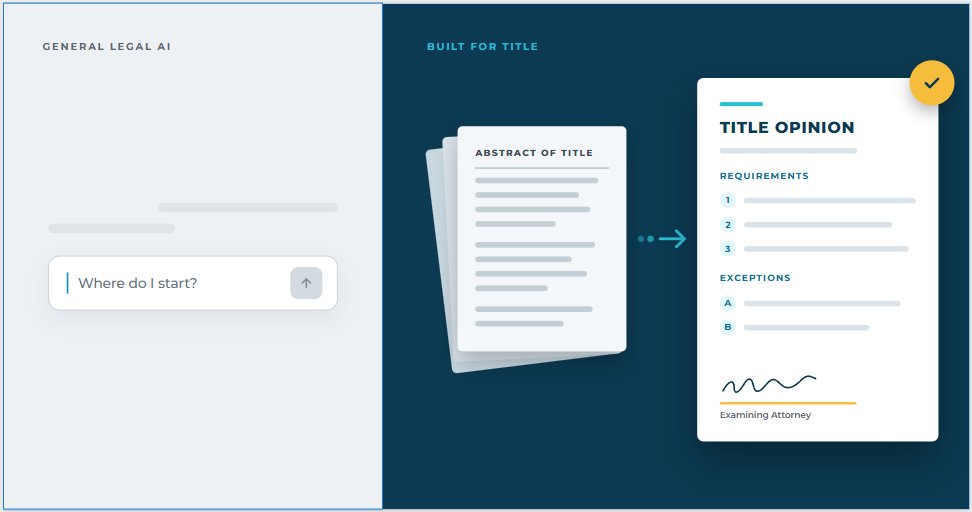
General tools start from a blank prompt. You bring the question and the documents, you shape the output, and the tool’s value is breadth. For a lot of legal work that’s exactly right. For a title opinion it leaves most of the work on the attorney’s desk.
What a Title Opinion Actually Demands
Anyone who has examined an abstract knows the job isn’t summarizing documents. It’s reading a chain of instruments in order, knowing what an unreleased mortgage from 1987 means for today’s buyer, and writing requirements and exceptions in the specific language your office, your underwriter, or your state’s title guaranty program expects. The format matters. The phrasing matters. Consistency across every attorney in the firm matters, because an opinion that reads differently depending on who wrote it is a liability, not a style choice.
That’s domain structure a general assistant has to be taught from scratch on every file, and it’s where the time actually goes. The slow hour in a title opinion isn’t the judgment call on the one real defect. It’s the transcription wrapped around it.
Where a Title-Specific Tool Fits
This is why we built Scribe around the opinion itself rather than around a chat box. Scribe starts from the abstract or the recorded instruments and returns a draft title opinion in the firm’s format. Agency-specific processing rules are set once and enforced on every draft for every user, so a first-year associate’s opinion follows the same standards as a senior partner’s. And for the attorney who has already examined the abstract on paper, or knows the file cold, Legal Pad lets them dictate or type their findings and get a draft opinion back with no documents uploaded at all. In practice, firms are drafting opinions up to six times faster.
The attorney still reads it, still decides, and still signs it. As the July 16 post on human-in-the-loop design argued, the loop only means something if the human is doing real work inside it. In a title opinion, the real work is the judgment. The drafting is what should come off the attorney’s plate.
You Don’t Have to Choose
None of this is an argument against general legal AI. A firm can run a general assistant for research and drafting across its practice and a title-specific tool for opinions and abstracts, the same way it runs a general word processor and a specialized closing system. The mistake is expecting the general tool to be the specialized one, running a six-week pilot to find that out, and concluding that “AI doesn’t work for title.” It works. It just has to be built for the job.
If your firm writes title opinions on abstracts, the practical test is simple: take a file you’ve already closed, run it through whatever tool you’re evaluating, and compare the draft to what you actually signed. That comparison will tell you more than any demo.
Harvey is a trademark of its respective owner. Electra Digital is not affiliated with or endorsed by Harvey. Product descriptions reflect publicly available information as of September 2026.